The short version
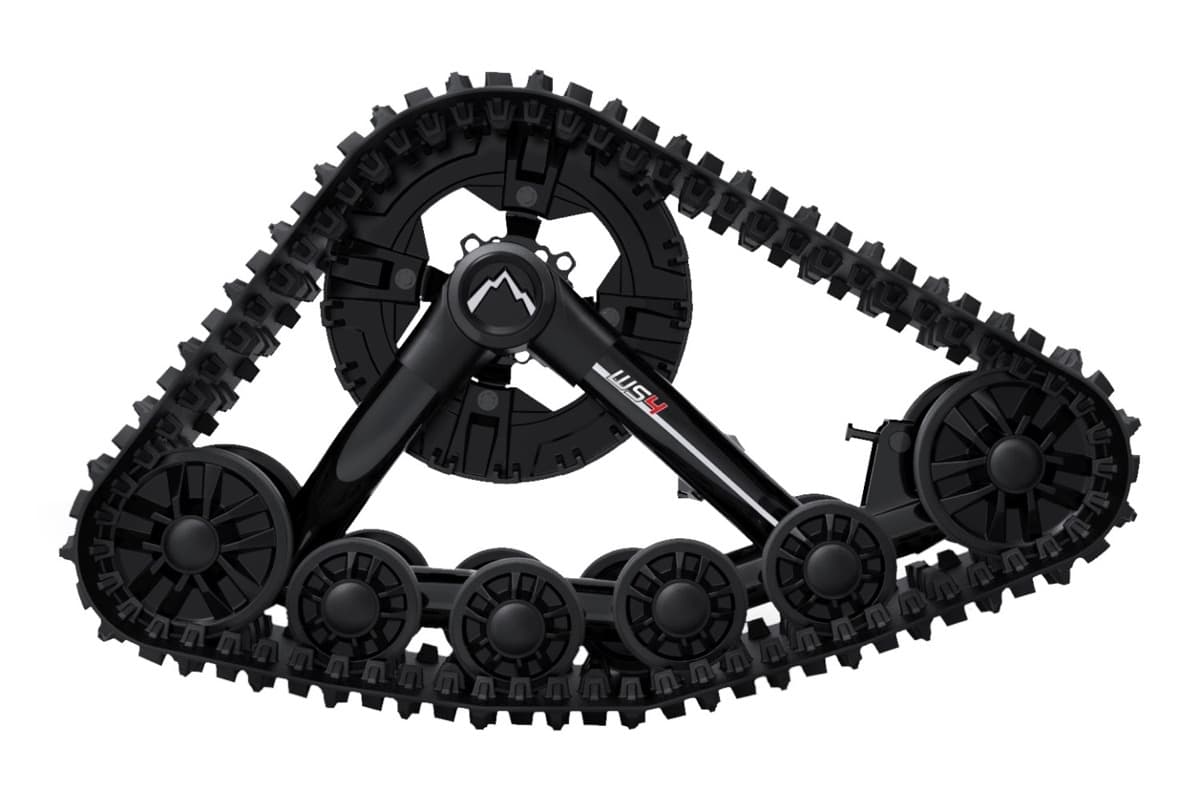
The Commander WS4 is Kimpex’s current ATV system, and it is built around one idea: put as much rubber on the ground as an ATV hub will carry. The rear belt is 330.2 mm / 13 in wide, and Kimpex publishes the footprint as 1.32 m² / 2045 in² across the set. If you ride deep snow or push a blade, those are the numbers you came here for.
Two things decide whether it is the right system for you, and neither is a dimension. The first is speed: Kimpex publishes a 35% loss, which is a real change in how a machine feels on a plowed road. The second is that the track kit is not the whole order. A Commander goes on a quad as four separate line items, and that is the single most common way a Commander purchase goes wrong.
What Kimpex publishes
| Figure | Front | Rear |
|---|---|---|
| Width | 292 mm / 11.5 in | 330.2 mm / 13 in |
| Length | 2460 mm / 97 in | 2540 mm / 100 in |
| Lug height | 25 mm / 1.00 in | 32 mm / 1.25 in |
| Weight, without mount kit | 72 lb / 32 kg | 75 lb / 34 kg |
| Flotation surface | 1.32 m² / 2045 in² total | |
| Ground clearance | Increase of 125 mm / 5 in | |
| Speed loss | 35% | |
| Sprocket | 15″ (381 mm), built for all-season use | |
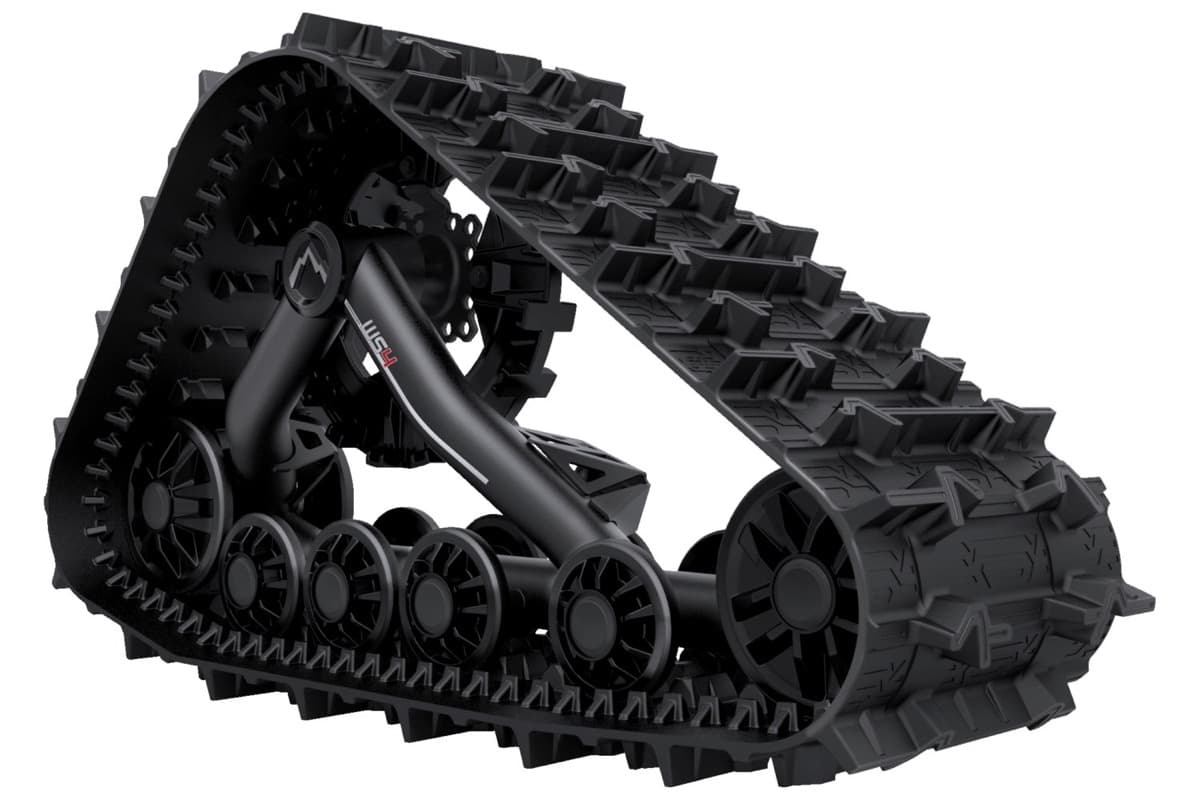
| Frame | Triangulated, 2.5″ (64 mm) steel tubing | |
| Initial installation | 1,5 hrs. | |
| Subsequent installation | 30 minutes | |
Kimpex calls the footprint row flotation surface and prints it in square metres and square inches; Camso calls the same row ground coverage and prints square inches only. Two names for one idea, so compare the width, length and lug figures instead — those both publish on the same basis.
Thirteen inches at the back
The front belts are the same width as Camso’s. Kimpex publishes 292 mm / 11.5 in at the front, Camso 11.5 in on the T4S. The difference between the two systems is entirely at the rear: 330.2 mm / 13 in against 12.5 in. Half an inch of belt width does not sound like much until you notice that Kimpex publishes the flotation figure split, and the split is where the argument for this system actually lives:
Flotation surface: 1.32 m² / 2045 in² total = 0.61 m² / 945 in² front & 0.71 m² / 1100 in² rearKimpex, Commander WS4 Track Kit, read 2026-09-26
More than half the published footprint is under the back of the machine, and that is the right place for it on a quad: the rear axle carries the drive, the rack load and most of the rider’s weight. A rear-biased footprint puts the flotation where the load already is, which is what you want in unpacked snow — the end doing the pushing is also the end least likely to sink.
The lug figures are not symmetrical either: 25 mm / 1.00 in at the front and 32 mm / 1.25 in at the rear. Front and rear belts are different belts on this system, so a single quoted lug height for a Commander is always half the specification. If somebody sells you a set on one lug number, ask which end it came off.
Camso publishes 1.125 in front and 1.25 inrear on the T4S. The rear lugs are the same height on both systems and the Camso front lug is the taller of the two, so the Commander’s advantage is belt width at the back rather than bite at the front. Worth knowing if your problem is a soft trail rather than deep snow.
The frame, the sprocket, and no slider shoe
Kimpex publishes a section for its frame, which is unusual — most of this category publishes a material and stops:
Triangulated frame composed of robust 2.5″ (64 mm) steel tubingKimpex, Commander WS4 Track Kit, read 2026-09-26
Tube rather than plate, triangulated from the drive axle to the front idler and back to the tail. The load that a track unit has to survive is the one that tries to fold it up under braking, and the frame is the only thing in the assembly that resists it. Tube of that section is a substantial structure for an ATV-sized unit, and it shows up in the weight figures below rather than being free.
The drive end is a single published sprocket — 15″ (381 mm) — where Camso publishes a tooth-count range and picks within it per machine. One sprocket means one less thing on the order to get wrong. It also means the gearing consequence is the same on every machine that takes the system, which is worth knowing before you read the speed figure.
The other published construction choice is the one that makes this a four-season system rather than a snow system. A slider shoe is a wear pad the belt runs on; systems that use one are biased toward snow, which lubricates and cools it. Kimpex leaves it out and says so:
System without slider shoe for all season performanceKimpex, Commander WS4 Track Kit, read 2026-09-26
Alongside it: wheels on two cap-protected ball bearings, and wheel contact patches coated in rubber to stop ice sticking to them. Those are small things that matter in March, when the riding is wet snow in the morning and mud in the afternoon. What the parts are called and which of them wear out is on what the parts are called.
The published speed loss
This is the figure to take seriously, and it is the one buyers discover after the first ride rather than before the order.
Speed loss: 35%Kimpex, Commander WS4 Track Kit, read 2026-09-26
Camso states the same idea as a fraction of what the machine had: keeping 2/3 of the vehicle's original speed. A flat percentage and a fraction are not worth splitting to the decimal point, and neither manufacturer publishes what it was measured on. Read both as the same instruction: a tracked quad is a low-speed machine, and anything involving a long haul down a plowed road is now a longer job than it was.
It also means your speedometer is lying to you, because it was calibrated on a rolling circumference the machine no longer has. If you ride anywhere that a posted limit applies, roads and shoulders is the page to read before you plan a route.
Weight, and the number the page actually gives you
Kimpex publishes 72 lb / 32 kg for a front unit and 75 lb / 34 kg for a rear, and it is the one manufacturer in this category that names what the figure leaves out — the page prints (without mount kit) ahead of the numbers. That is more useful than it sounds, because it tells you exactly what you are holding when you lift a corner and exactly what you are not.
The front and rear figures are close together, three pounds apart, and that is a practical difference from the Camso alternative rather than a specification curiosity: the T4S publishes 71 lb front and 83.7 lb rear. With a Commander, every corner is about the same lift and every space on the storage rack is interchangeable. With a T4S, the two rear units are the awkward ones.
What nobody in this category publishes is the weight of a fitted set, because the vehicle-specific hardware differs by machine. If the question is a trailer tongue or a shelf in the shed, weigh it — trailering a tracked quad covers what to weigh and what to measure.
An hour and a half, then half an hour
Kimpex publishes both install times, and this is the strongest thing on its spec sheet for an owner who runs wheels in summer:
Initial installation time: 1,5 hrs. · Subsequent installation time: 30 minutesKimpex, Commander WS4 Track Kit, read 2026-09-26
The first number is the one that includes fitting the adapter and the anti-rotation hardware. The second is the one you will live with, because the vehicle-specific pieces stay on the machine and the seasonal job is four units off, four wheels on. Half an hour twice a year is the difference between a system you swap when the snow comes and a system you leave on all year and wear out on gravel.
Camso publishes no install or swap time on either of its current ATV pages, so this is not a comparison — it is a figure that exists on one side and not the other. Treat the thirty minutes as a figure from a bench with the right tools laid out, not as your first attempt in a cold yard.
A Commander order is four line items, not one
This is the part of the review to read twice. Everything above is a specification; this is what actually goes wrong.
Kimpex sells the track kit and the vehicle-specific hardware separately, and publishes the sequence in its own words:
Select the proper track adapter (BOM1) depending on your VTT model
Select the proper Front anti-rotation (BOM2) and rear (BOM3)Kimpex, Commander WS4 Track Kit, read 2026-09-26
So a complete Commander order is four things: the WS4 track kit, the track adapter for your model, the front anti-rotation kit, and the rear anti-rotation kit. Three of those four are keyed to the machine rather than to the system.
A Camso order is one line. Camso sells a kit as four track systems plus an adapted mount kit to fit tracks on your vehicle (powersports.camso.co, read 2026-09-26), so “one T4S kit” is a set of tracks that bolts to a quad. “One WS4 track kit” is four units and a sprocket. It does not attach to anything on its own.
That is where buyers get caught, and it is not usually a dishonest sale — it is a cart with the obvious item in it and three model-specific selections that were never made. The symptoms are always the same: a pallet arrives, the wheels come off, and the machine sits on jack stands waiting for an adapter with a two-week lead time.
Two habits stop it. Ask for the order to be read back item by item before you pay — kit, adapter, front anti-rotation, rear anti-rotation — and ask whether all four ship together or on separate lead times. And if you change machines later, the four-part structure is suddenly in your favour: the units carry over and you re-buy only the three model-specific pieces. Camso’s bundled mount kit is easier to order once and harder to move between quads.
Buying a used set makes this sharper still. The vehicle-specific pieces are exactly what goes missing in a private sale, and they are the pieces you cannot substitute. Working out what is already bolted on covers what to photograph before money changes hands.
Two bolt-pattern variants, and why you measure
The WS4 is published in two variants, and between them they name the patterns an ATV hub is likely to be:
4/110, 4/115, 4/137
4/156Kimpex, Commander WS4 Track Kit, read 2026-09-26
This is one of the few places in the category where your own tape measure is the answer rather than an input to somebody else’s lookup. It is also a place to be careful: 4/110 and 4/115 are five millimetres apart on the diameter, which is not a difference a tape hooked over a muddy stud reliably resolves.
Record the reading, not the conclusion, and take it with the wheel off — measuring your own bolt pattern is a ten-minute job that removes the most expensive guess in a Commander order. Kimpex attaches no distinct catalogue number to either variant, so a part number off an old box will not tell you which one you are looking at.
Which machines have a Commander published for them
There are 733 published Commander WS4 applications, covering 691 distinct machines across 8 makes and model years 1995–2025. That is broad coverage of the mainstream makes, and it reaches a long way back — a mid-nineties quad is not automatically out of scope.
| Make | WS4 applications |
|---|---|
| Arctic Cat | 196 |
| Polaris | 168 |
| Can-Am | 135 |
| Honda | 82 |
| Yamaha | 66 |
| CFMOTO | 40 |
| Suzuki | 33 |
| Kawasaki | 13 |
The same data carries 5 makes with no Commander application at all — Argo, John Deere, Kymco, TGB, Textron. If your machine is one of those, the WS4 is not a choice you have, and the makes only Camso reaches is the page for you. The same is true a level down: there are families inside the covered makes that Kimpex skips, and they are on the families Kimpex skips.
Coverage is not the same as suitability, and the row for your machine does not tell you what the install will require of it. Which brings up the one thing about this system a buyer has to hear plainly.
An empty conditions column is silence, not a clean bill
Camso flags conditions against individual applications — a suspension lift required, a temporary body-part removal, a permanent interference — and defines them in a legend at the head of its guide. Kimpex publishes nothing of the kind: no per-machine condition data sits behind any Commander WS4 row.
So a WS4 row with an empty conditions column has had nothing published about it. It is not a statement that the install is bolt-on. It is an absence of a statement, and the two read identically in a table, which is exactly why owners get surprised on the lift.
The fix is a question, asked before the order rather than after: what comes off this machine, what stays off, and is anything cut or drilled. A shop that has fitted the combination knows. Documented installs on specific machines — including the ones where the answer was permanent — are in Field Notes.
One more absence worth naming for a practical reason: the product page states the application as ATV only and publishes no displacement range. Do not choose this system by engine size. Choose it by whether a published row exists for your year, model and trim, which is a different and much more reliable test.
The trade-offs, each as a published figure
Nothing below is a recommendation. Each line is a figure or a sentence one of the two manufacturers published, read on the dates in the notes, set beside what it costs — and then left there, because no published document compares the two ranges on a common basis.
- The widest published rear belt, and the longest published belts. Kimpex publishes 330.2 mm / 13 in at the rear against Camso’s 12.5 in. Neither manufacturer publishes what either figure does in snow of any given depth, and neither states a common basis for the footprint row underneath it.
- A published swap time, against four line items to get it right. Kimpex publishes an initial install and a subsequent swap as separate figures; it also sells the track kit, the adapter and the two anti-rotation kits as separate items, so a complete order is four correct selections rather than one.
- A speed figure is published; a condition is not. Kimpex publishes 35% for speed loss and nothing per machine about interference, clearance, removal or modification. The second of those is an absence of published data, and it is the largest one on this page.
- Coverage stops where the list stops. The published data carries 5 makes with no Commander application at all. That is no published Kimpex application for those makes — which is a statement about the list rather than about any machine on it.
- The rating is an application, not a displacement. The product page publishes Applications: ATV only and no engine-size band, so the test that settles a Commander decision is whether a published row exists for your year, model and trim.
Kimpex figures on this page were read from its own Commander WS4 page on 2026-09-26, and manufacturers revise those pages. Re-check anything you are about to spend money on, and get the four line items of a Commander order confirmed in writing before the deposit.