ATV Track Systems
Three systems are in wide circulation for quads, one outsider is rated against vehicle weight rather than engine size, Polaris sells its own on its own machines, one was withdrawn without a notice, and the rest turn up second-hand. What each one is built for, what the published figures actually say, how an order for it is assembled — and what none of their makers publishes at all.
What there actually is
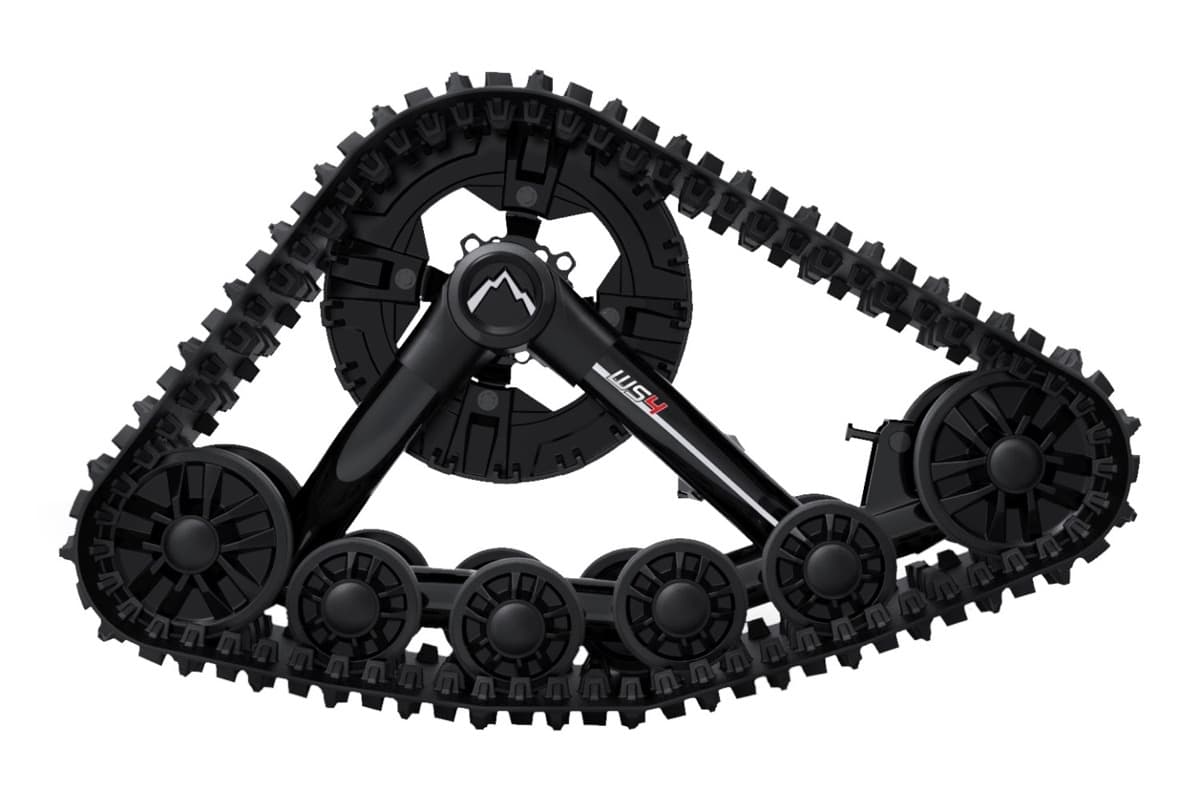
The field is narrower than a forum thread makes it look. Three systems are in wide circulation for quads: the Camso ATV T4S, the Camso X4S and the Kimpex Commander WS4. All three replace all four wheels, all three publish the same front track width, and all three are ordered against your machine’s year, model and trim rather than against its power.
Then there are three other situations. Mattracks sells the EZ ATV, which is rated against the machine’s gross vehicle weight instead of its displacement — a different question, and one you answer from your own loaded quad rather than from a lookup. Polaris sells a track system for Polaris machines through its own accessory channel, which makes it the only OEM route a quad owner has and the only one that comes from the same dealer that services the machine. And there are the lines that are gone: the small-bore Camso R4S, the 4S1, the Camoplast Tatou, the TJD X-Gen. You will not buy one new. You will meet one bolted to a used quad, at which point the question stops being whether it is any good and becomes whether the wear parts still exist.
The three in wide circulation
| Published figure | Camso ATV T4S | Camso X4S | Kimpex Commander WS4 |
|---|---|---|---|
| Track width, front | 11.5 in | 11.5 in | 292 mm / 11.5 in |
| Track width, rear | 12.5 in | 12.5 in | 330.2 mm / 13 in |
| Footprint, in the maker’s own words | Ground coverage: approx. 2000 sq. in. | Ground coverage: approx. 2000 sq. in. | Flotation surface: 1.32 m² / 2045 in² |
| Machine size published | 300 to 1000cc | All-terrain 300 to 1000cc; Side-by-side 400 to 700cc | ATV only |
| Published applications | 320 | 336 | 733 |
| Model years covered | 1986–2026 | 1986–2026 | 1995–2025 |
Front track width is the same 11.5 in on all three, so a tape across a front unit tells you nothing. The rear is where they part. The Commander publishes a rear track of 330.2 mm / 13 in against Camso’s 12.5 in, and longer belts at both ends — 97 in front and 100 inrear against Camso’s 93.4 in and 98.5 in. In unpacked snow that is the most concrete difference on the whole table, and it is the reason the Commander is the first one to look at if deep powder is what you are buying tracks for.
Camso’s counter-argument is at the front of the belt rather than in its size. Its front lug height is published at 1.125 inagainst the Commander’s 25 mm / 1.00 in, and both makers publish 1.25 in at the rear. Taller front lugs are bite where the machine steers, which is an argument you will feel on a side hill and in wet spring crust rather than on a straight run through powder.
One line on the footprint row, because it is the figure buyers most want to rank and the one that will not rank. Camso calls it ground coverage and publishes square inches; Kimpex calls it flotation surface and publishes square metres and square inches together; neither states a common basis for the measurement. Read each figure against that maker’s own line-up, not across the column.
T4S or X4S
On the published dimensions these two are the same system: identical track widths, belt lengths, lug heights, ground coverage and sprocket range. What separates them is what Camso says each is for. The T4S is published for all-terrain machines, 300 to 1000cc. The X4S is published for All-terrain 300 to 1000cc; Side-by-side 400 to 700cc— the same quad range plus a side-by-side range on top of it.
So if the shed holds a quad and a side-by-side, the X4S is the system Camso publishes for both, and that is the one useful reason to choose between them on paper. The unit weights differ by a pound or two as well, which matters when you are trying to tell one from the other on a barn floor and nowhere else — that job is An Unmarked System in a Barn.
Kimpex indexes the question differently again. The Commander page bounds the system by application — ATV — rather than by engine size, so displacement is not the figure that settles a Commander decision. The fitment list is. And whatever you fit, budget for the speed: Camso publishes the T4S as keeping 2/3 of the vehicle's original speed. A tracked quad is not a faster machine, it is a machine that keeps going.
How an order is assembled — the part that surprises people
This is a bigger practical difference between the two main ranges than any dimension in the table, and it is the one that changes what you pay.
Camso is one kit. Four track units together with the mount kit adapted to your vehicle. Pick the application for your machine and the machine-specific hardware comes with it.
Kimpex is four selections.The Commander track kit, then the track adapter for your machine, then a front anti-rotation kit and a rear anti-rotation kit. A Commander track kit on its own does not put tracks on a quad. Nothing is wrong with that — it is how the range is built — but it means the first number you see is not the price of a fitted set, and it means four correct selections instead of one.
Mattracks is a conversation. Its specification sheet is published per corner and its list price is published openly: $5,418 for the EZ ATV, read from mattracks.co/tracks/ez/ on 2026-09-26, with a recommended maximum GVW of 2,500 lbs on the EZ Series sheet. That is a manufacturer list price rather than the price of a fitted set, so it does not subtract cleanly from anything else on this page. Fitment goes through a request form answered by a person rather than a table you can look yourself up in, so work out what your quad weighs loaded before you make contact.
Polaris is a part number.The OEM system is ordered like any other accessory, through a Polaris dealer, against the machine it was built for. That narrows the decision to one brand of quad, and it keeps the whole after-sale conversation — fitting, consumables, anything that goes wrong — inside the network that already knows the machine.
One more thing worth knowing before you order rather than after: Camso’s two-year limited warranty is stated valid only when an authorized dealer installs the system. If you intended to fit the set in your own shop on a Saturday, that is part of the cost of doing so — Doing It Yourself and the Warranty works through what it covers.
Three things to settle before you choose
- What the machine is, in the words the fitment list uses.Year, make, model, trim, and which rear suspension it has. Badges and catalogue titles diverge more than they should — Identify is the section for that, and Machines shows what is published per make.
- Your bolt pattern, measured rather than assumed. Two diagonals and a tape measure, written down before you call anyone: Measuring Your Own Bolt Pattern.
- What you actually do with it. Deep unpacked snow rewards rear width and belt length. A plowed yard, gravel and hard-pack ask less of flotation and more of the wear parts, so the question there is what a slide, a bushing and a sprocket cost and how quickly you can get one. The list below shortens to one or two real candidates the moment you answer this honestly.
Two more questions, for anything outside the two main ranges
The Mattracks system, the Polaris OEM one and everything second-hand sit outside the Camso and Kimpex dealer channel, and two questions decide those that do not arise inside it.
- Who supplies the mounting hardware? The units are common to every machine and the mounting is keyed to one. Outside the main ranges that is the part to find a source for first, because it is the part that decides whether the system goes on your quad at all.
- For anything out of production, what wears out and can you still get it? Slides, bushings, sprockets and belts are consumables. Establish the parts route before the system rather than after — the small-bore system is the worked example, and What Nobody Publishes is the register of what none of these makers states in the first place.
The pages below take each system on its own terms — what it is built for, what its maker publishes about it, and what buying one involves.
Figures read 2026-09-26 from Camso’s ATV T4S and X4S pages, Kimpex’s Commander WS4 Track Kit page, and the Mattracks EZ Series sheet and product page. Application counts read 2026-09-26. Each of these makers reserves the right to change a published figure without notice, so re-read anything an order turns on.
- 01320 applicationsCamso ATV T4S
The quad-only Camso system: 11.5 in front and 12.5 in rear tracks, published for 300 to 1000cc machines, and shipped as four units with the mount kit for your vehicle.
- 02336 applicationsCamso X4S
Published dimensions identical to the T4S, but rated for side-by-sides as well as quads. What actually differs, and when it is the one to order.
- 03733 applicationsKimpex Commander WS4
The widest rear track and longest belts of the three, three wheels on the ground, no slider shoe — and an order assembled from four separate line items rather than one.
- 04Mattracks EZ ATV
Rated against your machine's gross vehicle weight instead of its displacement, priced openly, specified per corner, and bought from Mattracks.
- 05Polaris Prospector
The only OEM route a quad owner has, and only if the quad is a Polaris. Ordered as an accessory through the dealer that already services the machine.
- 06The Discontinued Lines
R4S, 4S1, Camoplast Tatou, TJD X-Gen. What you will meet on a used quad, what each one was, and whether the wear parts still exist.
- 07Camso's Small-Bore System Is Out of Production
Eight-inch tracks, a third less footprint, a 404 where the product page was — and parts that still exist.
- 08What Nobody Publishes
A register of absences: the figures no manufacturer states, and the questions the catalogue cannot answer.