The short version
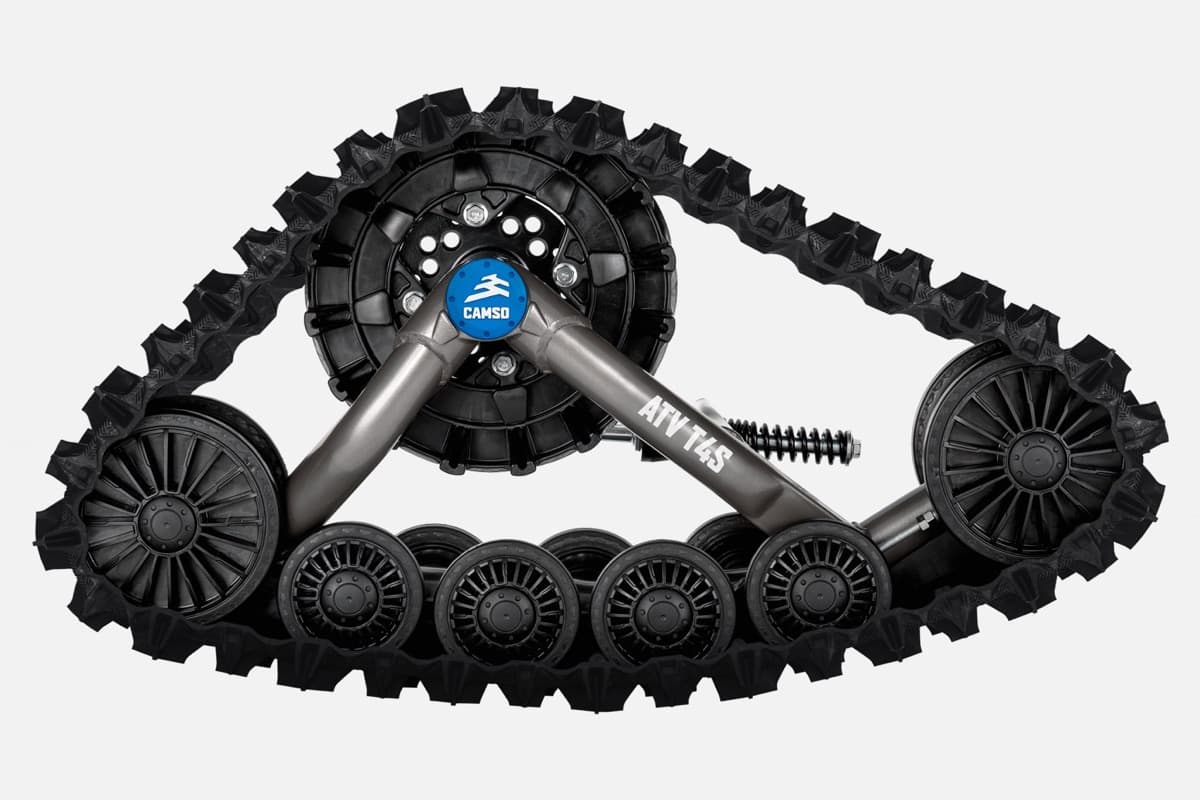
The T4S is the system Camso builds for quads and nothing else. One order, one box count: four units and the mount kit for your machine. It puts 12.5 in of belt under the back of the quad and 11.5 in under the front, and Camso publishes the footprint as approx. 2000 sq. in. across the set.1
Two things about it are worth knowing before you get as far as the dimensions. The first is speed: Camso’s own answer is that you keep about two-thirds of what the machine had. The second is the warranty, which Camso writes around an authorized dealer doing the install — so the labour is not an optional line on the quote, it is the thing the coverage depends on.
If your quad sits in the window Camso publishes — 300 to 1000cc — and it has a published row, this is the straightforward choice in the category. The interesting decision is not T4S against tracks in general. It is T4S against Camso’s own X4S, and the answer is decided by which machine you own rather than by any number on either page.
What Camso publishes
| Figure | Front | Rear |
|---|---|---|
| Track width | 11.5 in | 12.5 in |
| Track length | 93.4 in | 98.5 in |
| Lug height | 1.125 in | 1.25 in |
| Weight, one unit | 71 lb | 83.7 lb |
| System length | 40 in | 42.5 in |
| System height | 23.8 in | 23.2 in |
| Ground coverage | approx. 2000 sq. in. | |
| Ground clearance | F: 15 3/8 in · R: 14 5/8 in | |
| Avg. ground clearance | Increased by 3 in (*vs tires) | |
| Mount kit weight | 6.25 lb (approx.) | |
| Machine rating | 300 to 1000cc | |
| Speed | keeping 2/3 of the vehicle's original speed | |
| Warranty | 2-year limited | |
Camso calls the footprint row ground coverage and prints square inches; Kimpex calls the equivalent row on the Kimpex Commander WS4 flotation surface, and prints square metres and square inches. Two labels, one idea — compare track width, track length and lug height instead, which both publish the same way.
Everything is bigger at the back
Read the table down the rear column and the design argument is right there. The rear belt is an inch wider than the front, the rear lug is taller, the rear track is longer, and the rear unit is the heavier of the two. That is the correct bias for a quad: the rear axle carries the drive, the rack, most of the rider and whatever is on the hitch, so that is where flotation and bite have to be.
It is also the practical warning on this system. A front unit is 71 lb and a rear unit is 83.7 lb — a gap of 12.7 lb between the two corners you have to lift. The two rear units are the awkward ones, on the machine and on the rack, and they are not interchangeable with the fronts. Build the storage space around the rear pair, not around an average. Storing four track units covers what a rack actually has to hold.
The clearance figure is the one owners feel first. Camso publishes the fitted clearance as F: 15 3/8 in · R: 14 5/8 in, and separately as a change: Increased by 3 in (*vs tires). Three inches of lift changes how the machine feels long before it changes where the machine can go, and Camso lists the whole set of consequences in the manual rather than on the product page:
The installation of a System: • Increases ground clearance. • Changes the center of gravity. • Increases the ATV width and weight. • Reduces ground pressure.Camso ATV T4S Track System — Owner’s Manual, Safety — read 2026-09-26
Higher, wider, heavier, and a centre of gravity that has moved. None of that is a defect — it is the trade you are making for ground pressure. It does mean the first hour on a tracked quad should not be on a side hill.
The offsets are the numbers to take to a trailer, and the manual splits the width one by machine family: 7 in. (178 mm) on Polaris machines and 6 in. (152 mm) on everything else. The length offsets are 24 in. (610 mm) at the front and 27 in. (686 mm) at the rear.2 Measure your own machine once it is on tracks rather than working from the offset alone — trailering a tracked quad is where the width bites.
Two-thirds, and what that costs you
Camso answers this question on the product page, in its own FAQ, and the answer is more blunt than most of the category:
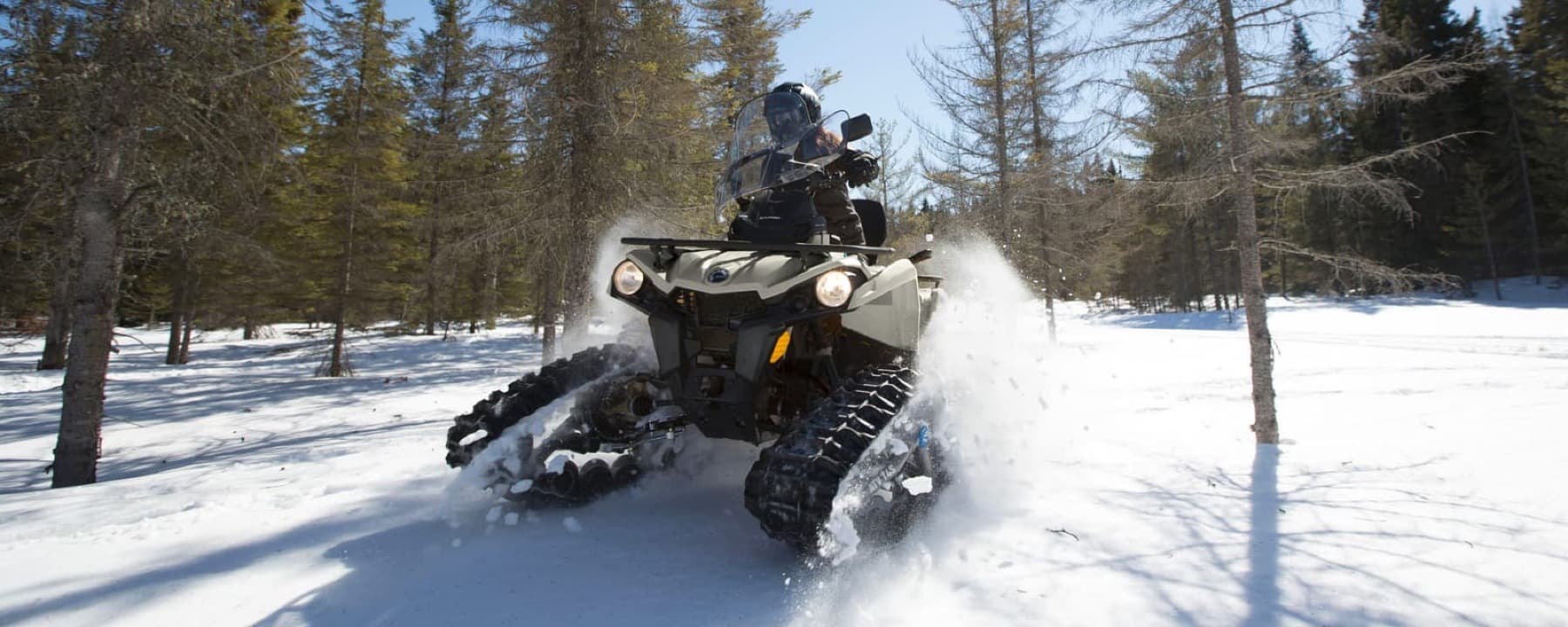
It's normal to experience an average speed loss of about 30% with a track system. Some vehicles may experience up to 50% in speed loss.Camso, ATV T4S, FAQ — read 2026-09-26
The same idea appears in the specification panel as keeping 2/3 of the vehicle's original speed. Take the pair together: plan for two-thirds, and accept that on some machines it is half.
What that does to riding is specific rather than general. Plowing a yard, breaking trail, pulling a sled or a log — none of that happens at a speed the tracks take away, and the torque trade goes your way. The job that changes is the transit: the four miles of plowed road between your gate and the good snow is now a long, loud errand, and a group ride with a wheeled quad in it will not work the way it used to.
Your speedometer is also now reading off a rolling circumference the machine no longer has. If any part of your route has a posted limit on it, roads and shoulders is the page to read before you plan it.
An order is one line
This is the T4S’s quiet advantage, and it is worth more than any half-inch of belt. Camso sells a kit as a set:
4 track systems (2 front, 2 rear) & adapted mount kit to fit tracks on your vehicleCamso, ATV T4S, What’s included — read 2026-09-26
So “one T4S kit” is a complete set of tracks that bolts to a quad: four units, two front and two rear, plus the mount kit adapted to your vehicle. There is no adapter to select separately and no anti-rotation hardware to forget, which removes the single most common way a track purchase goes wrong.
The mount kit is the half of the order that is keyed to the machine, and Camso publishes it at 6.25 lb (approx.). It is why the order starts with the year, model and trim rather than with the system: the units are the same on every quad, the mount kit is not, and a set bought used from a different machine is a set of units looking for a mount kit.
The sprockets are machine-specific too. Camso publishes 11 different front/rear sprocket combinations across the T4S rows, and 60 rows call for different tooth counts front and rear. Nobody eyeballs that from a photograph, which is another reason the fitment answer comes off the row for your machine rather than off a measuring tape.
One thing to write down the day the set arrives: the serial. Camso prints a blank for it inside the front cover of the manual, pre-filled with the family prefix — System Serial Number: 6622_ _ _ _ _ _ _. That prefix is shared with the Camoplast-era system that preceded this one, so the model year is what separates them later: a 6622 serial is ambiguous.
Parts are ordered the same way. Idlers, bogie wheels, belts and mount hardware are all selected against the system and the machine, and what the parts are called is the page to read before you ask for one by description.
The warranty is written around the installer
The product page states the term in six words: a 2-year limited warranty covering manufacturing defects in materials and workmanship. The warranty page states the condition, and the condition is the part that costs money:
The warranty is not valid if the System is not installed by an authorized Camso network dealer or distributor.powersports.camso.co/en-us/warranty, read 2026-09-26
The installing dealer is inside the sentence that creates the guarantee, not in a clause hung off the end of it. The period runs twenty-four months from the date of purchase — the purchase, not the install — and normal maintenance is outside it.3
Read that as a pricing instruction. A driveway install on a quad you already own is a real option and plenty of owners take it, but it is a decision about coverage rather than about an afternoon, and the trade is set out on doing it yourself and the warranty. Camso publishes no install or swap time for this system, so the shop fitting it is also the only place to get a straight answer about how long your machine takes.
Which machines have a T4S published for them
There are 320 published T4S applications, covering 315 distinct machines across 13 makes, model years 1986–2026.4 That is the mainstream of the quad market plus a long tail, and it reaches back far enough that an eighties machine is not automatically outside it.
5 of those makes — Argo, John Deere, Kymco, TGB, Textron — have no Kimpex application published at all, so for those owners this is the system rather than a choice between two. The makes only Camso reaches takes them one at a time.
The other end of the list matters for the same reason. The oldest T4S row is 9 model years older than the oldest Commander WS4 row, which is why this is the system that keeps turning up on a quad old enough to vote — tracks for a thirty-year-old quad.
The rows agree with the rating on the product page: the smallest machine with a published T4S row is 300cc and the largest is 1000cc, exactly the window Camso publishes as 300 to 1000cc. Below that window, Camso built a narrower small-bore system and no longer makes it — Camso’s small-bore system is out of production.
| Make | T4S applications |
|---|---|
| Arctic Cat | 74 |
| Can-Am | 61 |
| Polaris | 58 |
| CFMOTO | 30 |
| Yamaha | 28 |
| Honda | 23 |
| Kawasaki | 13 |
| Suzuki | 12 |
| Kymco | 6 |
| Textron | 6 |
| John Deere | 4 |
| Argo | 3 |
| TGB | 2 |
The variable that actually selects a kit is not the engine. It is the rear suspension: 195 of the published rows are A-arm independent and 125 are rigid axle or trailing arm, and two machines with the same name in the same year can sit in different rows because of it. Bring the year, model and trim as the machine is badged, plus the rear suspension type, and the answer arrives in one pass instead of three.
Camso flags the awkward installs, which is a feature
50 of the published T4S rows carry at least one remark against them, drawn from a legend Camso prints at the head of its own application guide. The flags are blunt and useful:
| Published remark | Rows |
|---|---|
| Temporary body parts removal | 19 |
| Temporary Vehicle modification | 18 |
| Permanent interference | 8 |
| Permanent vehicle modification | 7 |
| Suspension lift kit required | 7 |
| Vehicle with cargo box | 1 |
A remark is Camso saying the install is not simply bolt-on for that machine. What it does not say is what happens on the bench — which panel comes off, what is cut, which lift kit fits. That is a question for a shop that has done the combination, and the ones documented on specific machines are in Field Notes: the suspension lift nobody mentioned and what comes off a Grizzly or Kodiak are the two that change a quote.
The comparison that matters here is with what the other current range publishes, and it is an asymmetry in the documents rather than in the hardware. A flagged Camso row states that something about the install is not simply bolt-on; an unflagged row of any brand states nothing at all. On the two strongest flags — permanent interferenceand permanent vehicle modification — what it costs to find out afterwards is a cut fender.
Kimpex publishes no per-application condition data at all: every Commander WS4 record in this catalogue has an empty remarks field. The absence of a WS4 entry below means nobody has published a condition for it — not that none exists. Camso is the only manufacturer here that publishes these flags, so this page is necessarily a Camso view of the catalogue.
T4S or X4S
This is the real decision, and the two product pages make it look like a coin toss. They publish the same track widths, track lengths, lug heights and ground coverage, and Camso publishes one system envelope and one clearance row covering both. On published geometry there is nothing to choose between them.
Two things do differ. The weights: the T4S is 71 lb front and 83.7 lb rear, the X4S 72.6 lb and 79.4 lb. The T4S carries more of its mass at the back and has the heavier single unit of the two; the X4S is the more evenly matched set to lift, 6.8 lb apart against 12.7 lb. And the ratings: the T4S is published for quads only, at 300 to 1000cc, while the X4S carries two ratings — All-terrain 300 to 1000cc and Side-by-side 400 to 700cc — so it reaches mid-size side-by-sides as well.
The decision is made for you by the application guide, one machine at a time. Camso runs a part-number column per system, and on some machines the T4S column is blank while the X4S column is not.5 Those are the rows that matter:
| Make | Machine | Years |
|---|---|---|
| Arctic Cat | 400 Automatic TBX (2004-2006) | 2004–2006 |
| Arctic Cat | 500 Automatic 4X4 TBX (2004-2006) | 2004–2006 |
| Arctic Cat | 650 TBX (2007) | 2007 |
| Arctic Cat | 650 TBX (2009) | 2009 |
| Arctic Cat | 700 Alterra TBX (2020) | 2020 |
| Arctic Cat | 700 i EFI 4x4 H1 TBX / LTD / GT / XT (2010-2013) | 2010–2013 |
| Arctic Cat | 700 TBX / Super duty / Diesel / EPS / SE (2010-2017) | 2010–2017 |
| Polaris | 500 Sportsman X2 (2006-2007) | 2006–2007 |
| Polaris | 500 Sportsman X2 (2008-2009) | 2008–2009 |
| Polaris | 550 Sportsman X2 / EPS (2010-2014) | 2010–2014 |
| Polaris | 570 Sportsman X2 EPS (2015-2021) | 2015–2021 |
| Polaris | 700 Sportsman MV7 (2005-2006) | 2005–2006 |
| Polaris | 700 Sportsman X2 (2008) | 2008 |
| Polaris | 800 Sportsman X2 (2006-2007) | 2006–2007 |
| Polaris | 800 Sportsman X2 (2008-2009) | 2008–2009 |
| Polaris | 850 Sportsman X2 (2011-2012) | 2011–2012 |
| Textron | 700 Alterra TBX (2018-2019) | 2018–2019 |
That is the clearest practical rule on this page: if your quad is a box or two-up variant, the X4S is the system Camso publishes for it, and there is no published T4S row to go looking for. The cargo box is the reason — when the box is the problem works through those rows and what the flag means.
It runs the other way exactly once: Arctic Cat 650 Mud Pro EFI 4x4 H1 (2010-2011) has a published T4S application and no X4S one. For every other machine in the data, both systems are published — which means the choice between them comes down to price, stock and what your dealer can actually get, not to the spec sheet.
The trade-offs, each as a published figure
No page on this site tells you which system to buy. What follows is every trade this one involves, stated as the figure or the sentence the manufacturer publishes for it, read 2026-09-26— and then stopped, because the comparison that would turn these into a recommendation is not one the published record supports.
- Footprint against speed. Camso publishes approx. 2000 sq. in. as its ground coverage and keeping 2/3 of the vehicle's original speed in the same specification table. Both come from the same page; neither is stated as a consequence of the other, and no figure is published for what the exchange is worth on any particular surface.
- Clearance is published as a change, not as an outcome. Increased by 3 in (*vs tires), from Camso ATV T4S product page. Camso states the offset; it does not state what it clears.
- One order line, and one vehicle-specific half of it. Camso describes a kit as 4 track systems (2 front, 2 rear) & adapted mount kit to fit tracks on your vehicle. The units are the same product on every machine and the mount kit is not, so what varies between two quotes is the half that is keyed to the machine.
- The conditions are published, and only by one of the two ranges. 50 of the published T4S rows carry at least one remark. What the remark means on the bench is not published by anybody, and the absence of a remark elsewhere is the absence of a published statement rather than its opposite.
- The warranty is conditioned on who installs it. Camso publishes a two-year limited warranty valid when an authorized dealer installs the system, on powersports.camso.co/en-us/warranty, read 2026-09-26. That condition is part of the cost of a self-install and is worked through in Doing It Yourself and the Warranty.
- On the machines in the table above there is no T4S row to ask for. 17 machines carry a published X4S application and no published T4S one. That is a fitment fact rather than a preference, and it is the one case where the X4S is the system Camso publishes for the machine.
Camso figures here were read on 2026-09-26 from its own product page, owner's manual, warranty page and application guide. Camso revises all four, and the specification table is the one most likely to move. Check the current figures against anything you are about to spend money on, and get the warranty term and the installer in writing before the deposit.