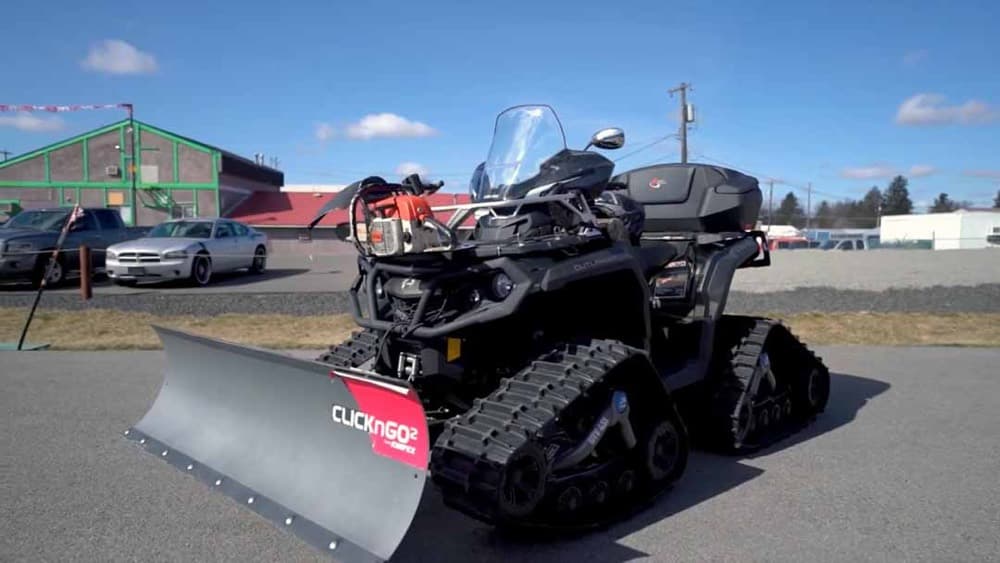
The four units are not the part that decides the price
Everyone shopping used looks at the belts. Belts are the easy part to judge and the easy part to replace. What decides whether a cheap set is a bargain or a boat anchor is the vehicle-side hardware: the mount kit, the hub adapters, the anti-rotation hardware, and on Camso-lineage systems the suspension kit that matches your rear axle.
That hardware is specific to the machine, and it is specific to whether the machine’s rear suspension is rigid or independent. The conversion kits are the proof that this is a hard fork rather than a detail: they are catalogued in both directions, rigid to independent and independent to rigid, matched per serial family and per model-year band. Nobody writes a kit for a difference that does not matter.
So the driveway questions, in order, are: are all four units here, is the mount kit here, and what machine was it bolted to? A complete set that came off a quad like yours is a weekend with a socket set. The same four units with no mount kit is four units, and you have just taken on the job of sourcing discontinued vehicle-specific brackets for a system with no product page.
The second thing that costs money after that is the wear list — slides, bushings, rollers, idlers and the belts themselves. Every one of these lines has parts documentation organised around exactly those components, which tells you what the people who stocked them expected to replace. Price a used set as though you are buying that list too. If it turns out you are not, you got a good deal; the other way round is how people end up with a tarped pile behind a shed.
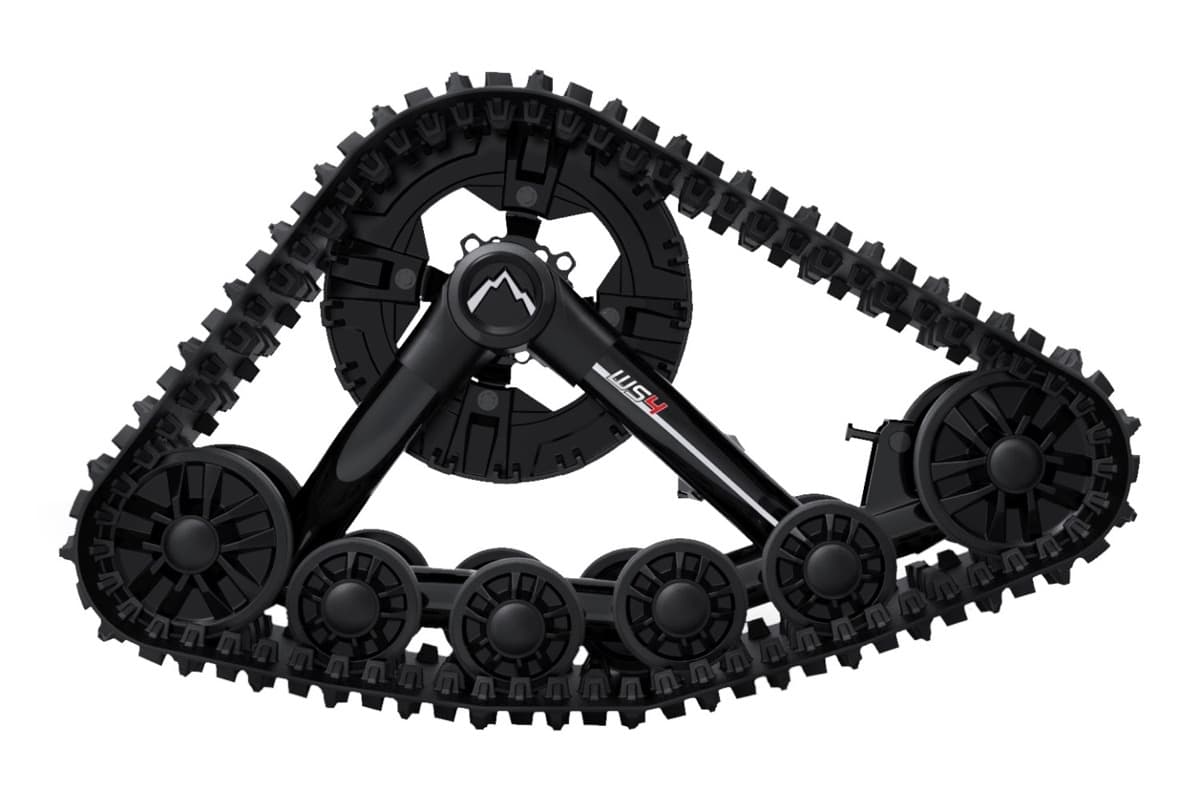
What each part is called, and what the same part is called in the other manufacturer’s list, is on the anatomy page. Knowing the words is most of the difference between a parts desk being able to help you and not.
Camso ATV R4S, 2017–2023
This was Camso’s small-bore system: the one built for quads below the displacement where the rest of the range starts. It is out of production, and it is the used line most worth finding, because a lot of the machines it suits have no current option with the same intent.
Camso’s sheet carries two different statements about machine size, on the same page:
designed for machines under 500 cc
300CC TO 500 CCCamso ATV R4S product sheet (PDF), camso.co, read 2026-09-26
One sets a ceiling, the other sets a floor as well. If your quad is under the lower figure you are inside one statement and outside the other, so get that settled before you build a plan on it — that is a question for Camso or a parts desk, not for a seller.
Recognising it with a tape measure
This is the one system here you can identify without a decal. Camso published the same track width front and rear for it, and the current systems all publish two different figures, the rear the wider of the two. Both ends are 8 in. (203 mm), which is also narrower than anything current.
Lay a tape across the track itself rather than across the frame, on all four corners. Matching front and rear points at this system. Unequal rules it out and you are looking at something else. That is the fast check; the R4S identification page carries the serial-plate detail and the model-year span the prefixes cover.
| Track width | front 8 in. (203 mm) · rear 8 in. (203 mm) |
|---|---|
| Track length | front 93.4 in. (2372 mm) · rear 98.6 in. (2504 mm) |
| Lug height | front 7/8 in. (22 mm) · rear 1 in. (25 mm) |
| Ground surface | 1 333 sq. in. (0.86 m²) |
| Maintained speed (average) | 2/3 |
| Frame | Lightweight powder coat steel frame |
Read the first two rows together and you get the single most useful thing to know in somebody’s shed: the rear track is longer than the front and its lug is taller, so a front unit and a rear unit are different parts. Count two of each. Four units of the same kind is not a set, whatever the seller believes.
Parts, and what that does to the price
The product page is gone and the old URL now lands on the Camso ATV T4S. The documentation did not go with it. The one-page sheet is still served, so is an owner’s manual for a 2023model year, and the exploded diagrams are still reachable — selected by serial family and by the system’s own model year rather than picked off a product page.
The suspension-conversion hardware is still catalogued against this family too, 2 entries covering both directions between a rigid and an independent rear axle. That matters to a used buyer specifically: it is what makes a set that came off the wrong kind of quad a possibility rather than a dead end. It is also the thing to price before you buy, not after.
The verdict.Buy one, on one condition. There is no published route to a single replacement unit, so completeness is not a nice-to-have — it is the whole deal. A set advertised as three good ones and a spare is a parts pile at a working-set price. Four units, two fronts, two rears, mount kit present: that is a good buy, and the wear parts behind it are documented well enough that you can keep it alive.
Camoplast Tatou and Tatou 4S
Two genuinely different track systems were sold under the Tatou name, and a listing will almost never tell you which one it is. They are documented separately, their parts are catalogued separately, and paperwork for one does not describe the other.
The later of the two is the TATOU 4S generation, recorded across 3 four-digit serial families for model years 2009–2016, under Camoplast and then Camso. The earlier one is distinguished by one word — Originalafter the family name — and that is the entire naming distinction. It is easy to miss on a screen and very easy to miss in an advert.
Here is the reason the later one is the safer buy. One of those families does not stop when the name does: the same four-digit code carries the Camso ATV T4S name from 2017onward. The paperwork trail runs forward into a system that is still sold, which is why a parts desk has somewhere to start with one. It is not a claim that parts interchange — nobody publishes that — but a lineage that continues and a lineage that stops are worth different money.
Telling the two apart
The badge narrows the era and does not settle the product, because both generations were sold under the older brand and one product name carried on after the brand changed. What settles it is the system’s own model year and which diagram groups its rear assembly matches, and the decode for the shared family code is on the 6622 serial page. The broader two-generation picture, including what to photograph, is on Camoplast Tatou and Tatou Original.
One practical warning for anyone reading a listing. No manufacturer specification sheet exists for either generation, so the track widths and weights quoted in adverts come from parts descriptions written downstream, not from the people who built the thing. If a width is quoted at you, measure it. What to measure on an unbadged system, and what each measurement settles, is on an unmarked system in a barn.
Parts, and the trap in searching for them
Both generations have per-year diagram sets behind them, which is more than most orphaned hardware gets. Two things about reaching them.
The earlier system’s diagram groups carry no vehicle-type value at all, so any list filtered by platform drops it — and an empty filtered list looks exactly like nothing existing. Ask for it by name and by track model year instead of concluding it is undocumented.
And the conversion hardware is still filed under the old name. 2 entries carry Tatou in their own titles, in the model-year band 2007–2009. Search the successor’s name and you will not find them; search the name on the frame and you will. That is a real cost difference on a set that came off a machine with the other kind of rear axle.
The verdict. A complete TATOU 4Swith its mount kit is worth real money as a working winter set — it is old hardware with a documentation trail that continues into a current line, which is about as good as discontinued gets. Budget for the wear list rather than hoping. The Original is a different proposition: nothing on the plate resolves to anything, the diagrams are the only documentation, and everything vehicle-specific on it is the better part of two decades old. Buy that one at parts money, or buy it because you watched it run.
TJD X-Gen and X-Track
TJD systems turn up cheap, and they are the ones sellers know least about. They sit outside every current fitment list, which means nobody can tell you from a table whether the set in front of you was ever published for a quad like yours. With a TJD set, the hardware in the driveway is the fitment evidence.
Recognition is by decal: one names X-Gen, the other X-Track. There is a third designation, XT4S, that turns up in parts paperwork and is defined nowhere — do not assume it expands to either name, because guessing lands you at the wrong diagram. If that is what your plate says, the TJD page is where that thread is pulled.
The good news, and it is better than the forums suggest: Camso hosts a substantial TJD document archive in its own service-and-support section. Folders for hubs, hub protectors, hub adaptors, adapter and fixation plates, stabilisation rods, steering limiters, lift kits, slides, bushings, rubber kits, track protectors and double wheels — plus an X-Track owner’s manual and standalone procedure documents for hub installation, differential cable adjustment and protection removal. For most jobs on a system you already own, the document is the thing you actually needed.
A used-system guide — utvtracks.com, read — states flatly that no factory parts are available from the manufacturer. Set that against two published things: the archive above, and a 2023 Camso dealer parts price file that carries TJD part lines — identification decals for both systems among them. Catalogued recently enough to be worth a phone call is not the same as in stock, and nobody publishes availability either way. Name the part from the archive and ask.
The verdict.These sit at the bottom of this page’s list on price, and not unfairly. Buy one complete, buy it cheap, and before you agree to anything photograph where the mount kit meets the hub. Vehicle-specific mounting is the part most likely to be unobtainable on orphaned hardware — and, being steel brackets, the part most likely to be fabricable by someone local. That decision needs a photograph, not a part name.
A 4S1 badge is a different question
Sets badged 4S1 come up in the same listings, and they do not belong in the group above. That plate family has a model-year run of its own, 2017–2023, and its suspension-conversion hardware is catalogued under titles that name UTV rather than ATV.
So with one of these, establish what machine it came off before you get anywhere near condition. A system assembled around a side-by-side and a quad meet at the vehicle-side hardware, which is exactly where this page started. Take the plate photograph to a parts desk and ask outright rather than taking the seller’s word for the platform.
The four lines side by side
| Line | Recognise it by | Parts behind it | What it is worth |
|---|---|---|---|
| Camso ATV R4S, 2017–2023 | Same published track width front and rear, 8 in. (203 mm), and narrower than anything current. Longer track and a taller lug at the rear, so fronts and rears are not the same unit. | Diagrams reachable by serial family and model year; suspension-conversion hardware still catalogued against the family. Sheet and a 2023 owner's manual both still served. | no published route to one replacement unit Documented well enough to keep running, on one condition: four units and the mount kit, or walk. |
| Camoplast / Camso TATOU 4S, 2009–2016 | TATOU 4S on the frame, Camoplast or Camso on the decal. The plate's four-digit family is shared with the system that replaced it, so the model-year segment is what separates them. | Diagram sets per track model year, and conversion kits still filed under the Tatou name rather than the successor's. | no manufacturer specification sheet Worth real money complete. Price the wear parts in, not out. |
| Camoplast Tatou (Original) | The word Original after the family name is the whole distinction. Predates every serial family, so a plate resolves to nothing. | Diagram sets per track model year, 2002 through 2009, carrying no vehicle-type value — a platform-filtered list drops them. | nothing on the plate to look up Parts money. As a working set only if it is running in front of you. |
| TJD X-Gen and X-Track | Decal names one of the two. A third designation, XT4S, turns up in the paperwork and is defined nowhere — do not assume it expands to either name. | A manufacturer-hosted document archive: part folders, an X-Track owner's manual, and procedure documents. Whether a given part can still be had is a phone call rather than a published figure. | vehicle-side hardware is the wall Bottom of this list on price, usually, and not unfairly. Complete, cheap, and only after you have looked at the hubs. |
How to discount a used set, in order
No published used price exists for any of these, and anyone quoting you one is quoting a feeling. What you can do is rank the configurations, which is most of what a price argument needs anyway. From strongest to weakest:
- Complete, with the mount kit for a machine like yours, and you watched it run. Nothing else in this list is close. You are buying a known-good install rather than a project.
- Complete, mount kit present, off a different machine. Subtract the vehicle-side hardware you now have to source, and on a Camso-lineage set find out what the suspension conversion costs before you agree a number rather than after.
- Four units, no mount kit. This is a parts purchase whatever the advert says. Value it as belts, rollers and frames, because that is what you are getting.
- Three units, or four that turn out to be four fronts.Parts money, full stop, on any line with no published route to a single replacement unit — which is all four of these.
- Cut belts, missing slides, seized rollers. Only worth buying where the wear parts are documented and you have checked they can still be named to a desk. On a line where they cannot, you are buying scrap with a story.
The driveway checklist
Everything here is done standing next to the set, before money changes hands, and none of it requires knowing what the system is called — that is what you are trying to establish.
- Count four units and confirm two fronts and two rears. On at least one of these lines the rear track is longer and its lug taller, so the halves are not interchangeable.
- Lay a tape across each track. Matching front and rear widths is a real identification; unequal widths tell you to keep looking.
- Photograph every decal and plate rather than reading numbers out. A photograph cannot transpose a character, and on the Tatou line the difference between two products is one word.
- Photograph the rear assembly square on from behind. The rear is where diagrams fork by suspension type; the front is usually common.
- Photograph where the mount kit meets the hub, both ends. The most expensive thing to discover late.
- Find out whether the donor machine’s rear axle was rigid or independent and whether yours matches. Mismatch means conversion hardware, and that is a line item.
- Note the model year of the track system if anything on it states one— not the quad’s year. Diagrams are keyed on the system’s year.
- Turn each unit by hand and listen. Rollers and idlers are the parts a stored set kills, and they are the parts you will be naming to a parts desk first.
- Measure your own wheel bolt pattern before you go.It narrows the fitment question faster than anything else — see measuring your own bolt pattern.
Getting parts named
For the three Camso-lineage systems on this page — the R4S and both Tatou generations — the route to hardware is an exploded diagram chosen by serial family and by the system’s own model year. Go in with the photographs rather than a retyped number, and be ready to say which platform it is on and whether the rear axle is rigid or independent.
For a TJD set, the documents are the manufacturer’s own and they are free to read. Get to your system’s folder, find the part, then ring somebody with its name in your hand.
If the set turns out not to be any of these, the place to start is measurements rather than names: an unmarked system in a barn. And if you are working the other direction — a specific quad, and what anybody publishes for it — that is under machines.
Manufacturer figures here carry the date they were read, and Camso revises and withdraws these documents without notice — re-read before you quote one at a seller. No part number appears on this page: the exploded diagram a part is ordered against is chosen by serial family and by the system's own model year, at a parts desk.